New home handover checklist (snagging list)
Before you accept the keys to a new home, check every room, list each defect with its location, and give the list to the developer with a repair deadline. Then tick items off at the follow-up visit.
Open the interactive checklist
No sign-up. Your notes stay on your device. Make the report in English or Chinese.
Download the printable PDF (A4, English + Chinese)
Before you start
- Bring your contract, floor plan and specification list.
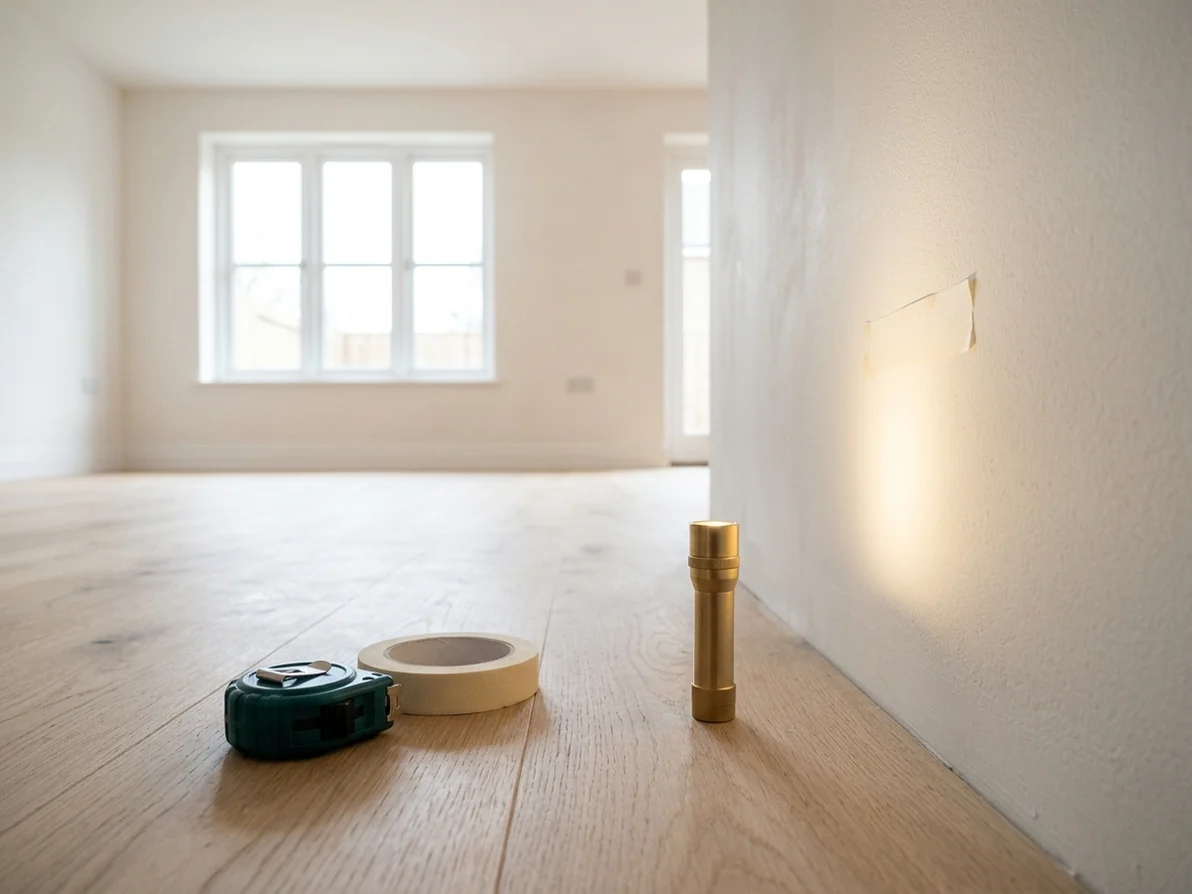
- Pack a torch, a coin, a plug-in socket tester, tape measure, masking tape and a bucket.
- Go in daylight and allow at least two hours.
- Write each defect with room, position and size, e.g. “bedroom 1 window frame, bottom-left: sealant cracked ~10 cm”.
- Structure, waterproofing, wiring and gas need a qualified professional if you have doubts.
The checklist, room by room
Tick each item OK, issue or not applicable. Grey text explains how to check.
Entrance
- Front door opens and closes smoothly, no rubbing
Open and close it fully 3 times and listen for rubbing. The gap around a closed door should look roughly even. - Every key, card or code opens the lock
Try each key or card yourself, not just one. A door closer should shut the door gently, not slam it. - No cracks where the door frame meets the wall
Look along all four sides of the frame for cracks or gaps in the sealant. Tools: Torch - Door and frame free of scratches and dents
Shine a torch at a low angle across the surface — scratches show up much more clearly. Tools: Torch - Doorbell / intercom works
Ask someone to ring from outside or from the lobby; check sound, video and the door-release button.
Living / dining room
- Walls have no cracks, holes or stains; paint is even
Shine a torch along the wall at a low angle; patches and dents become visible. Tools: Torch - Ceiling has no water stains or cracks
Pay attention near windows and outside walls. - Floor not cracked, chipped, scratched or hollow-sounding
Tap tiles with a coin; photograph scratches on wooden floors with something for scale. Tools: Coin - A marble doesn't roll away fast (rough level check)
Only a rough hint — ask a professional to measure if in doubt. Tools: Marble - Room door, handle and lock work
Open, close and lock it a few times. - Windows open, close and lock; screens and blinds OK
Slide or open each window fully. - No leak marks or mould around window frames
The bottom corners are the most common spots. Tools: Torch - Sockets are live and wired correctly
Use a plug-in socket tester; note any abnormal light pattern. Tools: Socket tester - Skirting boards and trims intact
Walk around the room once. - Lights and switches work
Switch each one on and off.
Bedroom (each)
- Walls have no cracks, holes or stains; paint is even
Shine a torch along the wall at a low angle; patches and dents become visible. Tools: Torch - Ceiling has no water stains or cracks
Pay attention near windows and outside walls. - Floor not cracked, chipped, scratched or hollow-sounding
Tap tiles with a coin; photograph scratches on wooden floors with something for scale. Tools: Coin - A marble doesn't roll away fast (rough level check)
Only a rough hint — ask a professional to measure if in doubt. Tools: Marble - Room door, handle and lock work
Open, close and lock it a few times. - Windows open, close and lock; screens and blinds OK
Slide or open each window fully. - No leak marks or mould around window frames
The bottom corners are the most common spots. Tools: Torch - Sockets are live and wired correctly
Use a plug-in socket tester; note any abnormal light pattern. Tools: Socket tester - Skirting boards and trims intact
Walk around the room once. - Lights and switches work
Switch each one on and off.
Kitchen
- Sink drains well, no leaks underneath
Fill the sink halfway, let it drain, then wipe the joints underneath with a tissue to see if they are damp. Tools: Tissue - Hot and cold water both work at the tap
Run both. Hot water may take a while if the heater has to start first. - Worktop has no chips, cracks or burn marks; sealant is continuous
Use a torch at a low angle along the worktop and the joint with the wall. Tools: Torch - Cupboard doors, hinges and drawers work and line up
Open and close every door and drawer once. - Cooker hood / extractor works
Try every speed; hold a tissue near it to feel suction. Tools: Tissue - Hob and oven switch on
If gas or power is not connected yet, mark N/A and note it for a follow-up visit. - Kitchen sockets are live
Use a plug-in socket tester on each socket. Tools: Socket tester - Appliances and fittings match the specification list
Compare each model plate with the specification attached to your contract. Tools: Spec list
Bathroom (each)
- Floor drains well, no standing water
Pour a bucket of water and watch where it goes; photograph any puddle left behind. Tools: Bucket - No drain smells
Check that floor drains have a water trap or anti-odour cover. - Toilet flushes, refills and is firmly fixed
Flush twice and watch the cistern refill; push gently to make sure it doesn't rock. - Basin drains well, no leaks underneath
Run water, then wipe the joints underneath. Tools: Tissue - Shower / bath: hot and cold water and pressure OK
Try hot and cold and switch between tap and shower head. - Tiles not cracked, chipped, loose or hollow
Tap tiles lightly with a coin; a clearly hollow sound can mean poor adhesion. Mark spots with masking tape and photograph. Tools: Coin, masking tape - Silicone sealant intact, no mould
Check around the bath, shower tray, basin and toilet base. - Extractor fan works
Switch it on and hold a tissue near the grille. Tools: Tissue - Shower screen or door closes properly, seals in place
Open and close it a few times; look for missing or loose seals. - Ceiling access hatch opens; no water marks inside
Open it and look at pipes and the slab above with a torch. Tools: Torch
Balcony / utility area (each)
- Floor drains, no standing water
Pour water and watch it flow to the drain. Tools: Bucket - Railings are firm
Push firmly by hand. If height or strength looks doubtful, ask a professional. Tools: Tape measure - Washing-machine water supply and drain are in place
Check there is a tap and a drain and enough space for a machine. - Balcony door or window slides and locks
Slide it all the way and lock it. - Water heater / boiler looks properly installed and vented
It should be fixed firmly and vent to open air. Gas appliances should be checked by a qualified technician. - No damp stains or white salt marks on walls or ceiling
White powdery deposits (efflorescence) often point to moisture. Photograph the location.
Whole home
- Breaker panel is labelled; RCD / GFCI test button trips
Press the test button, confirm it trips, then reset. If you are not comfortable doing this, ask the person handing over. - Smoke alarms (and CO alarms where required) present and working
Press each test button. Note any missing or painted-over alarm. - Meter readings photographed (electricity, water, gas)
Take a clear photo showing the numbers. This sets who pays for what from today. - Keys, fobs and remotes counted and tested
Write the number of each in the note, e.g. "3 keys, 2 fobs, 1 garage remote". - Heating / air-conditioning works
Switch each unit on for a few minutes. For new homes, check the pipe holes, drains and sockets are in the right places. - All lights and switches work
Switch each one on and off. - No construction debris or strong odours left
Include inside cupboards and around access hatches.
Parking, storage & mailbox
- Parking space number and location match the contract or lease
Compare with the plan or lease. - No leaks or standing water around the space
Look at the ceiling and walls nearby. - Mailbox and storage unit are accessible with your keys
Try each key.
Paperwork & handover
- Specification list compared item by item
Your contract attachment is the reference. If a model differs, note it and ask whether it is an approved equivalent. Tools: Spec list - Defects written onto the developer's handover form with a repair deadline
Keep a copy. Use this report as your attachment. - You know whether your contract lets you hold back part of the payment until defects are fixed
This depends on your country and contract. Example: Taiwan's pre-sale contract rules let buyers retain 5% of the price until repairs pass a joint re-inspection. - Warranty card and user manuals received
Check what is covered and for how long. - Backup or printed copy saved
Use Export backup on the report page, or print to PDF.
General checkpoints only — not a legal standard, a professional inspection or legal advice.
Open the interactive checklist
No sign-up. Your notes stay on your device. Make the report in English or Chinese.
Download the printable PDF (A4, English + Chinese)
Taiwan example: 5% handover retention
Under Taiwan's mandatory terms for pre-sale housing contracts (item 13), the seller must provide an inspection form, defects must be written on it and repaired within a set time, and the buyer may retain 5% of the total price until repairs pass a joint re-inspection. Other countries have different rules — check your contract.
Source: Taichung City Government consumer-protection page (Chinese) (checked 2026-11-06).
Questions
Should I hire a professional inspector?
This checklist helps you look carefully yourself. Whether to hire a professional depends on the home and your budget; hidden leaks, structure and wiring need instruments.
What if the developer disagrees that something is a defect?
Write it down anyway with photos and ask them to explain in writing. Your contract and local rules decide.
How do I track repairs?
In the interactive version, open the report after repairs and mark each item fixed or not fixed.